Enrol Today
St Anthony’s College offers relevant, dynamic and engaging curriculum for Prep to Year 12

Vocational Education and Training (VET) gives students practical, industry-relevant skills and the opportunity to complete nationally recognised training while at school.
VET can support pathways into employment, apprenticeships, traineeships, further vocational training and university study.
Depending on the qualification and the student’s individual circumstances, VET can provide:
A completed VET qualification at Certificate III level or higher may also be used as one input in an ATAR calculation when combined with four General subjects. Students should discuss their individual senior pathway with the College before selecting a VET course.
The following qualifications are currently available through the College, subject to sufficient enrolments, staffing, resources and ongoing arrangements with the relevant Registered Training Organisation (RTO).
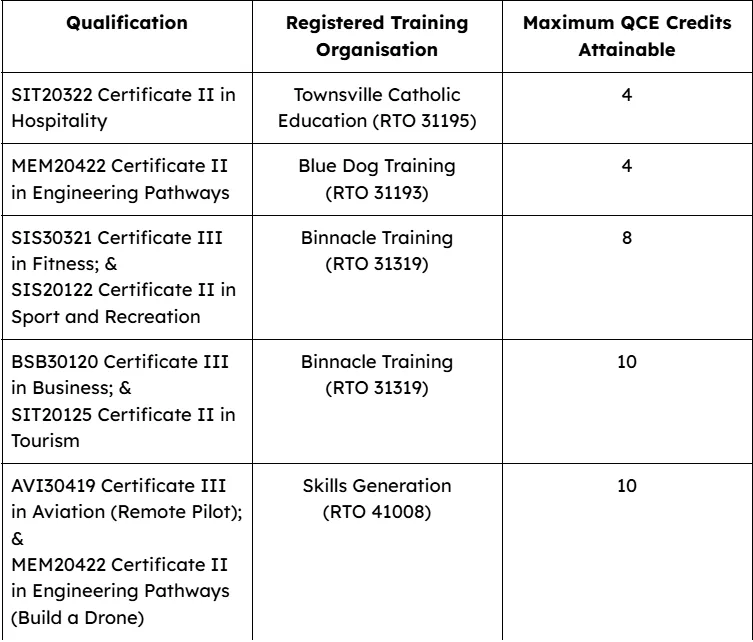
The figures shown are the maximum QCE credits available. The credits awarded to an individual student may be lower because of incomplete study, credit transfer, duplicated learning or previous completion of units from the same training package.
St Anthony’s Catholic College is not the issuing Registered Training Organisation for these qualifications. Qualifications and Statements of Attainment are issued by the RTO identified above.
Depending on the qualification, training and assessment may be delivered at the College by approved College staff on behalf of the RTO, by trainers employed by the RTO, or through a combination of these arrangements.
Course availability, qualification codes, fees, delivery arrangements and eligibility requirements may change. Students and families should consult the current Senior Subject Handbook and course information supplied during subject selection.
Students may also apply for VET courses delivered outside the College through approved training providers.
External courses may involve:
External qualifications, delivery locations and application dates change regularly. Students must consult the VET Coordinator before applying or enrolling so that course suitability, timetable implications, costs and funding eligibility can be reviewed.
Work experience gives students an opportunity to explore an industry, observe workplace practices and develop a clearer understanding of possible career pathways.
Work experience is a short-term, unpaid placement. It does not result in a nationally recognised qualification or QCE credits, but it can help students:
Students interested in a school-based apprenticeship or traineeship are strongly encouraged to complete work experience in the relevant industry, preferably with the prospective employer, before seeking College approval.
Arranging work experience
Students and families are expected to identify and contact a suitable host employer. The College can support this process by providing:
The College must review the proposed placement and complete the required agreement and insurance processes before the student can attend.
How to Secure a Holiday Work Experience Placement
Placement periods
The College coordinates a designated work experience program for eligible Year 10 students each year. Dates and application deadlines are communicated separately.
Short placements during school holiday periods may also be considered. Holiday work experience is generally limited to five days per placement and must be requested with sufficient time for the College to complete the approval process.
Placements during ordinary school weeks will only be considered where there is a clear educational or pathway benefit and the student can appropriately manage the impact on their schoolwork.
The College will provide the required agreement documents and explain the responsibilities of the student, employer, family and College.
A school-based apprenticeship or traineeship combines:
School-based apprenticeships and traineeships are generally available to students in Years 10, 11 and 12. They require a substantial commitment and may involve regular time away from school.
Students interested in this pathway are strongly encouraged to complete work experience in the relevant industry, preferably with the prospective employer, before seeking College approval.
Before approving an arrangement, the College will consider:
College approval is not automatic. Students must complete the College’s School-Based Apprenticeship or Traineeship Request process before the College endorses a training contract.
Students should speak with the VET Coordinator before committing to an external course, apprenticeship, traineeship or other vocational program.
For VET, external training, work experience, apprenticeship or traineeship enquiries, contact:
Mr Christopher KyleVET CoordinatorEmail: vet@sacc.catholic.edu.au
| Padua Campus | Assisi Campus | |
|---|---|---|
| AddressA | Veales Road, Deeragun |
Joanne Street, Deeragun |
| PostalP | PO Box 143 |
PO Box 143 |
| PhoneT | 07 4751 7200 |
07 4751 7300 |
We acknowledge the traditional custodians of this land of the Wulgurukaba and Bindal people and pay our respects to the elders past, present and future.